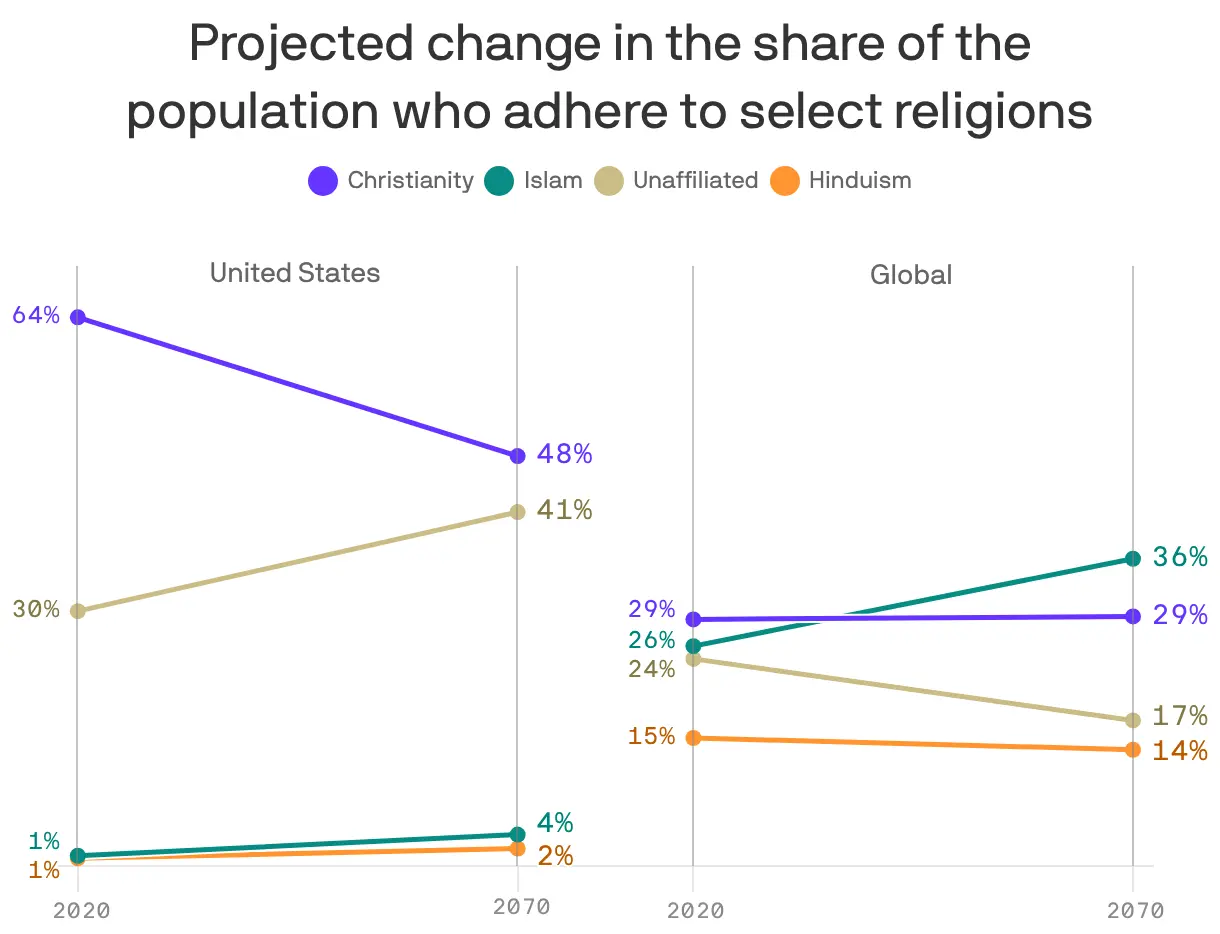
Why it matters
The change reflects demographic trends, not a wave of people switching religions. Pew’s data show that between 2020 and 2070 the global Muslim population will increase by about 1.6 billion people, driven by natural growth (births minus deaths). In the same period, the Christian population is projected to rise by roughly 792 million through natural increase.
Fertility differentials
From 2020 to 2025, Muslim women averaged 3.1 children each, compared with 2.5 for Christian women and 1.6 for women of other faiths. These higher fertility rates are a key factor behind Islam’s rapid expansion.
Expert insight
David Voas, a professor at University College London who studies secularisation, says the numbers are „driven by demographic change.” He notes that the fastest‑growing regions—North Africa, the Middle East, the Near East and South Asia—already have large Muslim majorities, making a future demographic majority for Islam almost inevitable.
Shifts in the United States
The United States is expected to lose more Christians than any other nation by 2070, even as global Christianity continues to grow. In 2020 the U. S. held the world’s largest Christian population at 217 million; by 2070 that figure is projected to fall to 174 million. By contrast, the Democratic Republic of Congo is forecast to have nearly 300 million Christians by 2070, overtaking the United States. At that time, 54 % of all Christians will live in sub‑Saharan Africa.
Geographic centre of Christianity
Voas points out that „the centre of gravity of Christianity is moving toward the Global South.” While Christianity originated in the West, it was carried to Africa and elsewhere, and today Africa is growing faster than any other region.
Conversion trends
Both Islam and Christianity are expected to lose more adherents through switching or disaffiliation than they gain through conversion. However, the net loss will be far larger for Christianity.
Implications
Even if Islam becomes the world’s largest religion, Voas cautions that this does not automatically translate into a dramatic shift in global political or cultural power in the medium term. He dismisses speculation that Europe will be „taken over” by Muslims, calling such forecasts unlikely in the foreseeable future.
Conclusion
While Islam is poised to become the most populous faith, the numbers alone do not signal a seismic change in worldwide influence. The projection has already sparked partisan tension in Congress over anti‑Muslim remarks from some Republican members.