Dragon Galaxy Luminosity and Gravitational Lensing Phenomenon
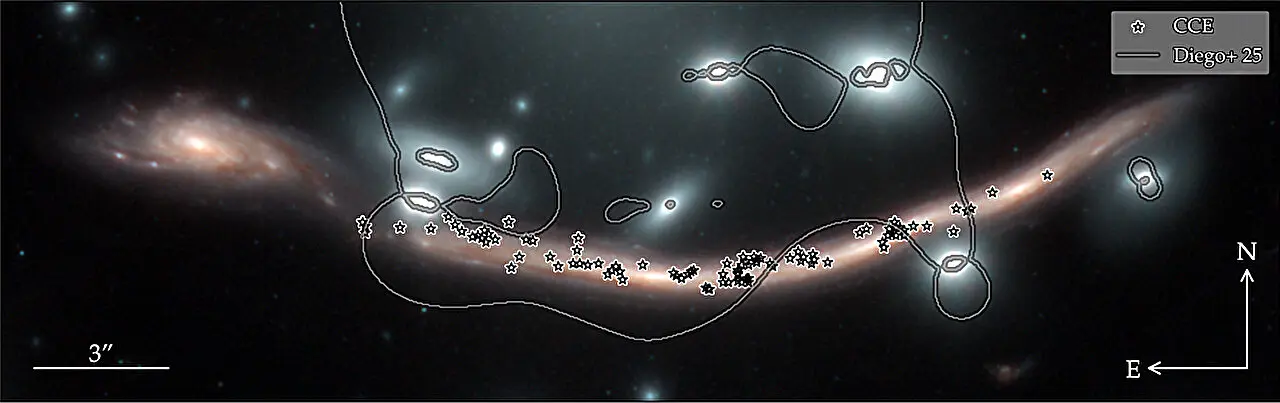
The Dragon galaxy has a redshift of 0.725. Its light is distorted and amplified by the massive Abell 370 galaxy cluster. A section of this galaxy forms the Dragon arc. This process is known as gravitational lensing. The lensing effect is not uniform across the observed area. Light from Dragon can focus intensely on specific caustic lines. This causes a dramatic brightness increase. The cluster is not perfectly uniform. Its gravity bends light differently in various regions. Stars in the cluster and dark matter cause minor additional distortions. These lead to „microcaustics.” Caustic Event Mechanism As the background galaxy moves slowly relative to the lensing cluster, individual stars cross these microcaustics. This triggers a caustic crossing event. During the crossing, two images of the same star merge. The star reaches peak luminosity, potentially hundreds or thousands of times its normal level. After the crossing, the two images vanish.
The star returns to its usual brightness over days or weeks. Because these events are temporary, astronomers identify them by comparing images of the same distorted region taken at different times.
Research Methodology: From Data to Catalog
This new study was coordinated by José María Palencia of the Institute of Physics in Cantabria. The team compared JWST images from 2022 to 2024 to find brightness variations. They applied meticulous corrections to remove false residuals or artifacts from image stacking. They isolated real luminosity changes. They also removed unrelated bright objects and the galaxy's luminous core. To set the normal noise level, they used a similar image far from the critical curve. This curve is where amplification is maximum and microlensing does not occur. Combining repeated detections across filters and sessions confirmed 104 unique stellar events. The work states, „we obtain a catalog of 104 unique CCEs in the Dragon arc, which represents currently the largest sample of strongly magnified stellar candidates identified in a single galaxy.” Color Analysis: Blue and Red Supergiants Only the brightest stars are visible during these events. Most detected objects are supergiants.
Clues to Dark Matter: The FuzzyModel
They are classified as blue supergiants (BSG) or red supergiants (RSG). BSGs are hot stars emitting mostly short wavelengths. RSGs are cooler and emit mainly in near-infrared light. The ratio between these two types informs the galaxy's stellar composition. Younger, low-metallicity populations yield more bright BSGs. Older, higher-metallicity populations evolve toward the red category. A key question is the blue-to-red ratio in the Dragon arc. A chromatic analysis showed approximately equal numbers of blue and red supergiants, resulting in a 1:1 ratio. This supports a relatively evolved system that still forms stars.
Dark matter in the galaxy cluster might help form the microcaustics. The event pattern can thus help clarify its nature. To test this, the team monitored event numbers on both sides of the critical curve. Away from the critical curve, the event count was equal on both sides. Near the curve, the count dropped on one side but remained constant on the other. This distribution model fits the fuzzydark matter hypothesis. This is a theoretically proposed form.