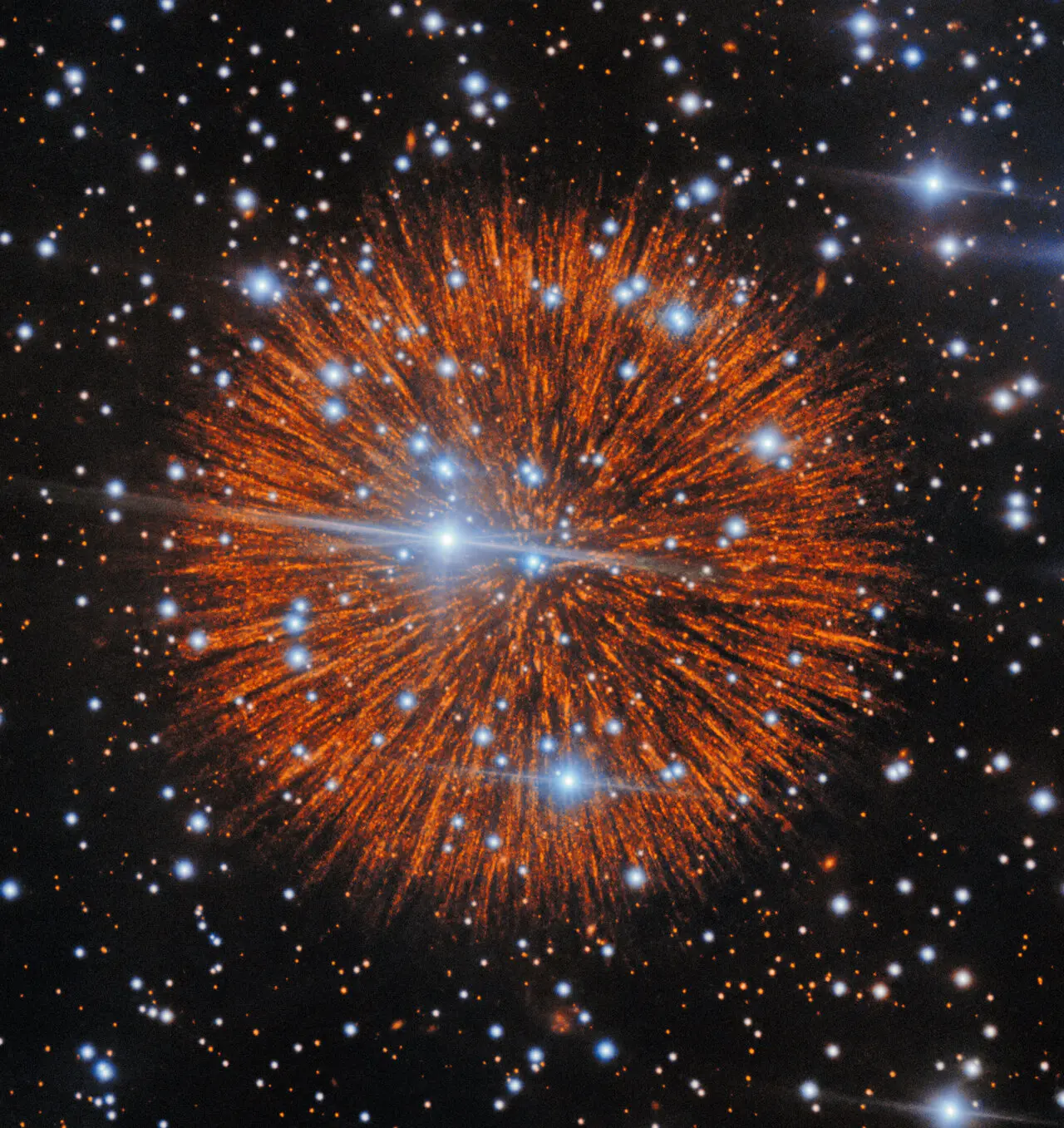
What caused the pearl-like structure in this remnant?
Astronomers have captured detailed images of a rare supernova remnant in the Milky Way, revealing an intricate structure unlike any other known in our galaxy. Located thousands of light-years from Earth, the remnant displays delicate, pearl-like chains of glowing material formed by the explosive death of a massive star. The observations were made using advanced telescopes that detect specific wavelengths of light emitted by heated gas and dust.
The remnant, identified as the only one of its kind in the Milky Way, shows a complex network of filaments and knots that resemble a string of pearls. Scientists believe this structure formed when the supernova shockwave interacted with dense, pre-existing clouds of interstellar material. Unlike typical remnants that expand uniformly, this one exhibits clumpy, organized patterns suggesting a highly structured environment around the progenitor star. The findings challenge previous assumptions about how supernovae disperse their material into space.
How does this discovery change our understanding of supernova remnants?
Researchers propose that the unique shape resulted from the star’s final stages, during which it ejected material in uneven shells or rings. When the supernova explosion occurred, its blast wave hit these layers at different times and speeds, creating instabilities that led to the formation of dense, glowing knots. These knots, visible in the new images, are composed of elements like oxygen and neon, forged in the star’s core and expelled during the explosion. The spacing and brightness of the pearls provide clues about the density and distribution of the surrounding medium.
This remnant offers a rare glimpse into the messy, non-spherical reality of stellar explosions. Most models assume symmetric expansion, but this object shows that local conditions can dramatically shape the aftermath. By studying such exceptions, astronomers can refine simulations of how supernovae enrich interstellar space with heavy elements essential for planet and star formation. The pearl-like chains may also serve as a laboratory for studying plasma physics and shock dynamics in extreme environments.
What makes this supernova remnant unique compared to others in the Milky Way? It is the only known remnant in our galaxy displaying a distinct, organized pattern of pearl-like chains, suggesting a highly structured interaction between the explosion and surrounding material.
Frequently Asked Questions
How far away is this remnant from Earth? The remnant is located several thousand light-years away, though the exact distance is still being refined through ongoing observations and data analysis.
Can we see this remnant with the naked eye or amateur telescopes? No, the remnant is too faint and emits light primarily in specific wavelengths not visible to the human eye, requiring specialized instruments for detection.