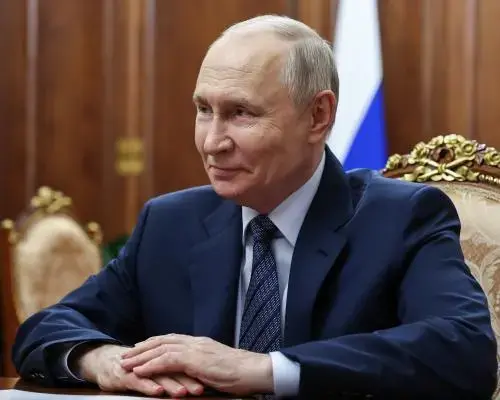
Election Results Reflect Consolidation of Power
Recent parliamentary elections in Russia confirmed a dramatic consolidation of power under Vladimir Putin, with 49 veterans of the Ukraine conflict winning seats in the new legislature. Authorities announced the figures after the ruling United Russia party recorded a sweeping victory in an election widely criticised for its organisation. Preliminary data showed the pro-Kremlin party won a record 355 seats in the State Duma, the lower house of parliament which has 450 members in total. This result gives United Russia a supermajority even larger than the historic 343 seats it won in 2016, underscoring the tightening of Putin’s control over domestic politics.
First Elections Since Full-Scale Invasion
These elections represent the first held since Moscow launched its full-scale invasion in 2022. Vladimir Yakushev, secretary general of United Russia, initially said 86 veterans of the „special military operation” could be elected, describing it as a substantial contribution, but later revised the estimate to the final figure of 49. Speaking on the significance of the vote, Dmitry Peskov, Kremlin spokesperson, said the results reflect maximum societal cohesion around the state leader, who has governed Russia either as president or prime minister since 2000.
International Condemnation and Domestic Crackdown
Western governments condemned the election, particularly in occupied Ukrainian territories, calling it a „farce”. Tensions were heightened by last month’s decision by Russia’s Supreme Court to ban participation in elections by the Yabloko party, the sole opposition force opposing the war, leaving liberal voters without a clear alternative to express dissent. Kaja Kallas, the European Union’s top diplomat, characterised the event as „a major new setback for Russian democracy”. In a post on platform X, she noted that the Kremlin had silenced dissent and excluded international election observers, concluding that „the façade of democracy is all that remains”.
Speculation of Mobilisation and Escalating Conflict
The electoral context coincides with speculation that Putin could announce a massive mobilisation campaign this autumn, aimed at reinvigorating Russia’s stagnant military efforts. Ukrainian President Volodymyr Zelenskyy suggested Moscow seeks to recruit an additional 300,000 soldiers. In recent months, Russia has intensified bombardments, striking Kyiv and other Ukrainian cities with jet-propelled attack drones. In response, Ukraine launched deep strikes, hitting an oil refinery in Moscow last Sunday, an action Zelenskyy dubbed „long-term sanctions”. Russian forces have also intensified efforts to capture towns in the Donbas region, including Kramatorsk and Sloviansk, though they have yet to break through Ukrainian defences, with Ukrainian commanders reporting their own counteroffensive near the town of Lyman.
Domestic Repression and Opposition Exclusion
Inside Russia’s borders, criticism of the war is prohibited, and anti-war bloggers have been arrested and imprisoned. Local politician Boris Nadezhdin, who previously attempted to run for president on a peace platform, was excluded from the September elections and labelled a „foreign agent”. All other parties that won seats in this election support the „special military operation”. These include the Communists, who came second with 40 seats, the ultranationalist LDPR with 25 seats, and the New People party with 20 seats. Ramzan Kadyrov, leader of Chechnya and a close Putin ally, was re-elected, declared the winner with over 99% of the vote.
Official Results and Ongoing Attacks
Ella Pamfilova, head of Russia’s electoral authority, declared that United Russia won a landslide victory with 57.83% of the vote, based on 95% of ballots counted, compared to 49.8% in the last parliamentary election in 2021. She praised voters for resisting „psychological pressure”. The previous night, Russia carried out what Zelenskyy described as a „brutal, targeted” attack on the southern city of Zaporizhzhia. He said a nine-storey residential building, a university structure, a shopping centre, and a thermal power plant were damaged, and five people were injured. A woman from the Kharkiv region was killed in a drone strike. Zelenskyy concluded: „Russia is not reducing its escalatory actions and signals preparation to expand the war. All of this unfolds against a backdrop of global stability already shattered by this conflict. We must continue to pressure the aggressor to end this war.”