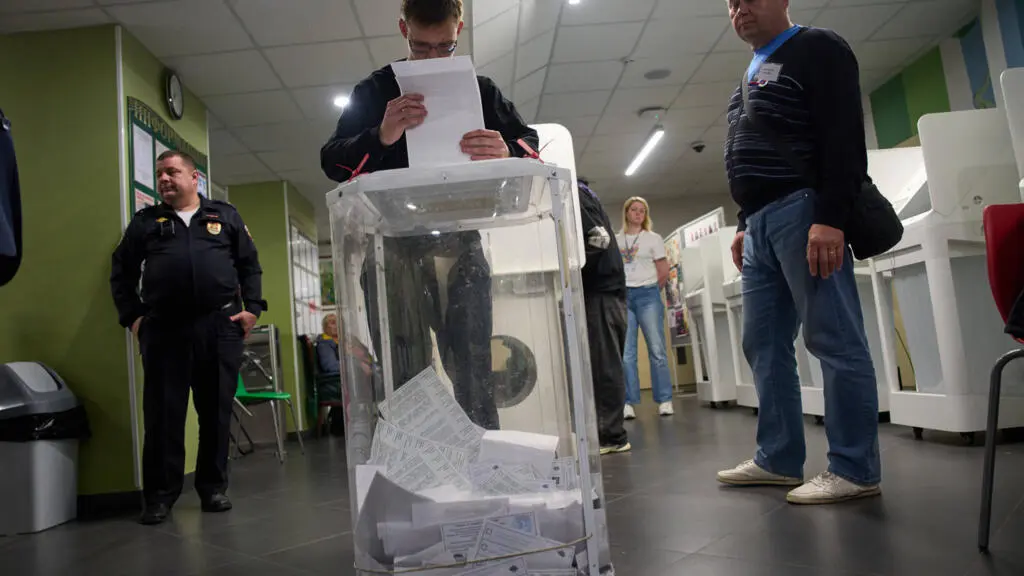
United Russia’s Dominance Amid a Turbulent Campaign
Moscow’s ruling United Russia party clinched a commanding majority in the State Duma on Monday, according to official tallies released by state broadcasters. The vote took place amid a wave of cyber intrusions targeting election infrastructure and a series of large‑scale Ukrainian drone attacks that struck several Russian regions over the weekend.
The election, held under heightened security measures, saw United Russia capture roughly 68 % of the seats, consolidating President Vladimir Putin’s grip on legislative power. Opposition parties struggled to gain traction, citing limited media access and alleged voter intimidation. Meanwhile, the Kremlin’s security council announced plans to „respond decisively” to the recent drone barrage that damaged oil facilities in the southern oblast and disrupted power grids in the north. Analysts link the attacks to Ukraine’s intensified aerial campaign, aimed at undermining Russia’s war logistics.
United Russia’s victory reflects a continuation of the party’s long‑standing dominance since the early 2000s. Election officials reported a turnout of 71 %, slightly higher than the previous cycle, suggesting that state‑run mobilization efforts succeeded in bringing voters to the polls. Party leader Dmitry Medvedev praised the result as a „mandate for stability and victory,” while opposition leader Alexei Nekrasov dismissed the figures as „manufactured.”
Will Moscow’s Threat of Retaliation Escalate the Conflict?
Cybersecurity experts warned that several hacking groups, believed to be linked to foreign intelligence services, attempted to breach the Central Election Commission’s servers in the days leading up to the vote. Although officials claimed the attacks were repelled, independent monitors noted irregularities in vote‑counting software in three districts. The government responded by deploying additional cyber‑defense units and tightening internet controls, further limiting online discourse during the counting period.
In a televised address, Defense Minister Sergei Shoigu vowed that Russia would „not tolerate aggression against its sovereign territory” and promised „swift and proportionate” measures against the drone strikes. Military spokespeople hinted at possible strikes on Ukrainian air bases and the deployment of advanced air‑defense systems along the border.
Ukrainian officials, however, argued that the drone attacks were a legitimate response to Russia’s ongoing missile campaigns in Ukrainian cities. „We are defending our people,” said a senior Ukrainian military commander, adding that the drones were launched from within Ukrainian‑controlled territory. International observers cautioned that any escalation could draw neighboring states into a broader confrontation, especially as NATO monitors increased patrols in the Black Sea.
The parliamentary win gives United Russia a solid platform to pass legislation that could tighten media restrictions, expand surveillance powers, and allocate additional funds to the defense sector. Critics warn that the combination of a reinforced legislative majority and a hawkish security posture may limit diplomatic avenues for de‑escalation.
Frequently Asked Questions
What percentage of seats did United Russia win? United Russia secured about 68 % of the 450 seats in the State Duma, giving it a decisive majority.
How many drone attacks occurred in the last week? At least six major drone strikes were reported, targeting oil refineries, power substations, and a military training ground across different Russian regions.
What are the potential repercussions of Moscow’s retaliation pledge? If Russia follows through with retaliatory strikes, the conflict could intensify, risking civilian casualties and prompting a stronger NATO presence in the area, which may further destabilize the region.