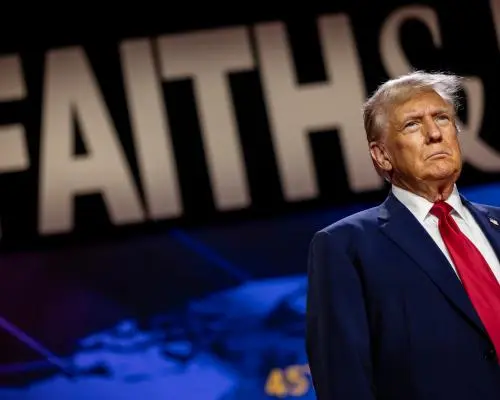
The Demographic Engine Behind the Alliance
Robert P. Jones argues that a waning white Christian influence has pushed some voters toward Donald Trump, raising alarms about historical parallels. In his new book, the demographer examines census data, voting trends, and the rise of Christian nationalism to ask whether the United States is slipping toward authoritarianism reminiscent of 1930s Europe.
Jones, a senior fellow at the Pew Research Center, spent months analyzing population shifts, religious affiliation statistics, and election results from 2016 to 2024. He found that the share of white evangelical Christians who identify as „culturally conservative” has fallen, yet their political clout remains disproportionate because of concentrated voting power in swing states. This paradox, he says, has forged a strategic alliance with former President Trump, whose rhetoric often invokes themes of cultural war, national rebirth, and „purity” that echo early‑20th‑century populist movements.
Jones points to a 12‑point drop in the proportion of Americans who describe themselves as „white Christian” between 2010 and 2022. Despite this decline, the group’s voter turnout rate stayed above 70 percent, outpacing the national average. In key battlegrounds such as Ohio, Pennsylvania, and Florida, evangelical voters accounted for nearly half of the margin that secured Trump’s victories in 2016 and 2020.
Does Comparing Trump’s America to Nazi Germany Serve a Purpose or a Pitfall?
„Numbers tell a story of a shrinking base that is becoming more politically efficient,” Jones said in an interview. „When a demographic feels threatened, it often doubles down on identity politics, seeking leaders who promise to restore a perceived lost order.”
He also highlights the surge of „Christian nationalist” sentiment, measured by a Pew survey that found 55 percent of white evangelicals now believe the United States is a „Christian nation” by divine right. This belief, Jones argues, fuels a willingness to overlook democratic norms in favor of policies that align with a religiously framed vision of the country.
Critics warn that invoking Nazi analogies can trivialize the Holocaust and inflame partisan divides. Yet Jones contends that the comparison is not about equating scale but about recognizing warning signs. He cites three historical markers: the erosion of independent media, the vilification of minorities as existential threats, and the centralization of power in a charismatic leader.
What the Future Holds for American Democracy
„Hitler’s Germany did not become a dictatorship overnight,” Jones noted. „It was a gradual process of normalizing extremist rhetoric, just as we see incremental shifts in political discourse today.” He acknowledges the danger of hyperbole but insists that scholars must remain vigilant when democratic safeguards weaken.
The book has sparked debate among historians, political scientists, and civil rights groups. Some argue that the United States’ institutional resilience—an independent judiciary, a free press, and a robust civil society—makes the Nazi comparison historically inaccurate. Others point to the rise of „law‑and‑order” rhetoric, voter suppression tactics, and the politicization of the National Guard as evidence of an alarming trajectory.
If the current alignment between declining white Christian influence and Trump‑style populism persists, Jones warns that the United States could see further polarization and a weakening of democratic norms. He urges policymakers to address the underlying cultural anxieties driving this alliance, suggesting reforms that promote inclusive civic education and protect minority rights.
Ultimately, Jones calls for a balanced conversation: one that respects the gravity of the Holocaust while using its lessons to safeguard democratic institutions. By confronting demographic anxieties head‑on, the nation may prevent the slippery slope that history warns against.
Frequently Asked Questions
Is it accurate to say the U. S. is becoming a „Christian nation” by law? No. While many white evangelicals view the country through a religious lens, the Constitution guarantees separation of church and state, and no legislation has redefined the nation’s legal identity.
How does voter turnout among white evangelicals compare to other groups? White evangelical voters consistently turn out at rates above 70 percent, significantly higher than the national average of roughly 60 percent in recent elections.
What steps can reduce the risk of authoritarian drift? Strengthening independent media, enforcing voting rights protections, and fostering inclusive education about democratic values are widely recommended measures to counteract authoritarian tendencies.