Investigating Hidden Processes Inside the Furnace
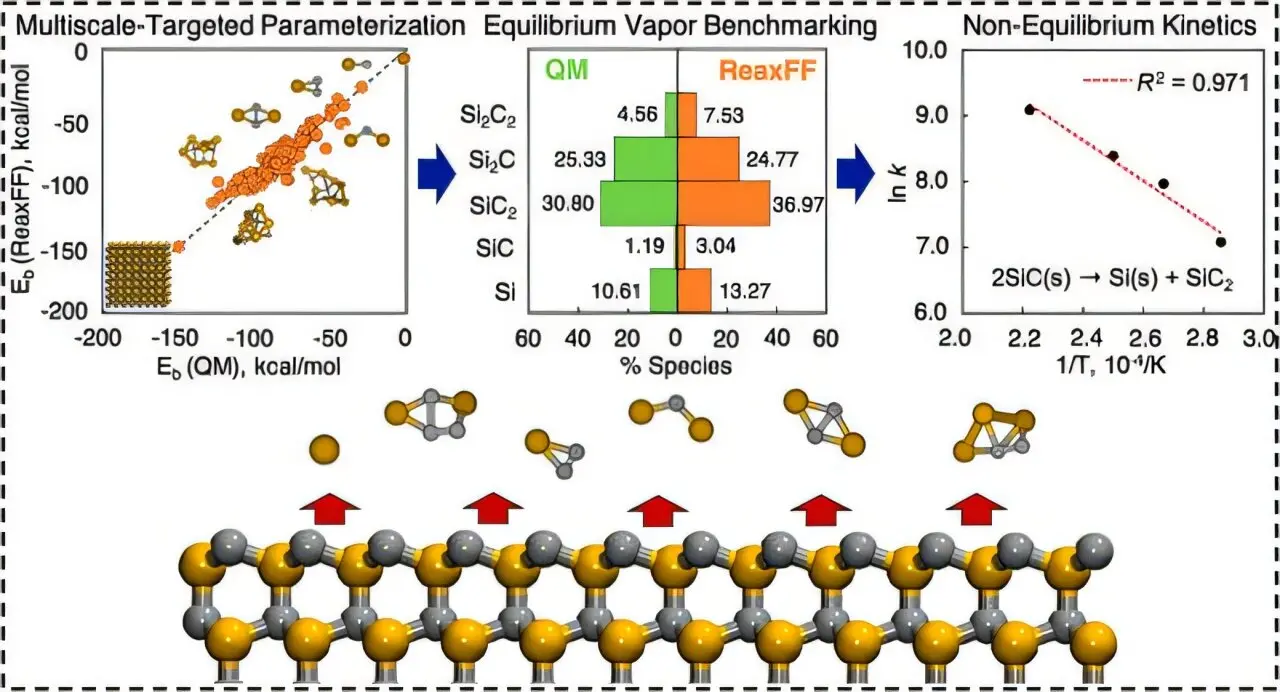
SiC is vital for high-power electronics. Examples include electric vehicles and clean energy infrastructure. SiC growth uses the Physical Vapor Transport (PVT) method. Solid SiC heats until it turns directly into vapor. This vapor then deposits onto a seed crystal, forming a larger crystal. Extreme furnace temperatures make observing early sublimation stages very hard. Researchers could not precisely identify the specific molecules in the vapor. Yun Kyung Shin, a research professor in mechanical engineering at Penn State and the study's lead author, noted this limitation. He stated, Due to these extreme circumstances, direct in situ experimental observation inside a closed PVT furnace is practically impossible, leaving a critical gap in understanding vapor and early sublimation dynamics. Investigating Processes Inside the Furnace To study this invisible process, the team refined the ReaxFF computational method. Adri van Duin, a mechanical engineering professor at Evan Pugh University, co-invented and developed this technique.
A force field uses mathematical rules to calculate atomic interactions. ReaxFF can also model chemical reactions. This allows tracking atomic movement, bond breaking, and new bond formation over time. While not new, the prior SiC-carbon version was calibrated mainly for SiC oxidation. Sublimation involves different chemical pathways. This requires breaking solid material bonds and forming vapor species. Thus, the researchers re-parameterized the force field using extensive quantum mechanical calculations.
Changes in Vapor Composition Based on Temperature
The improved model tracked various silicon and carbon molecules forming as SiC heated into vapor. Results strongly matched detailed quantum mechanical calculations. Laboratory tests supported the prediction that the remaining solid material becomes progressively richer in carbon. Simulations also showed vapor composition changes with rising temperature. The mix and specific ratio of silicon and carbon reaching the seed crystal significantly affects crystal quality. Shin explained, „The change in vapor composition with temperature is determined by the distinct sublimation energies of different gaseous species.”He added that at lower temperatures, silicon-rich species, like pure silicon and silicon-carbon, preferentially leave the source material due to lower evaporation activation barriers. Too much silicon vapor can cause silicon droplets or major defects on the seed crystal. Excess carbon can lead to graphitization or other defects, altering the desired SiC structure.
From Atomic Reactions to Furnace Design
Shin clarified that understanding temperature effects on the vapor helps producers adjust heating conditions for optimal crystal quality.
The team also calculated temperature-dependent rates for key sublimation reactions. This data can feed into future computational fluid dynamics models. These models simulate furnace-scale conditions. They include heat transfer, gas flow, and temperature gradients. However, they need precise chemical data on vapor composition. Combining atomic reaction data with furnace-scale simulations allows for more realistic virtual growth experiments. Shin concluded, „Ultimately, this allows producers to optimize furnace geometries and thermal recipes solely through simulations, reducing dependence on costly and time-consuming trial-and-error growth processes.” Complementary Models Covering Different Growth Scales A related study, published in Journal of Crystal Growth and led by researchers from Morgan Advanced Materials, covers different growth scales.