Why This Discovery Matters for Cosmic Particle Mysteries
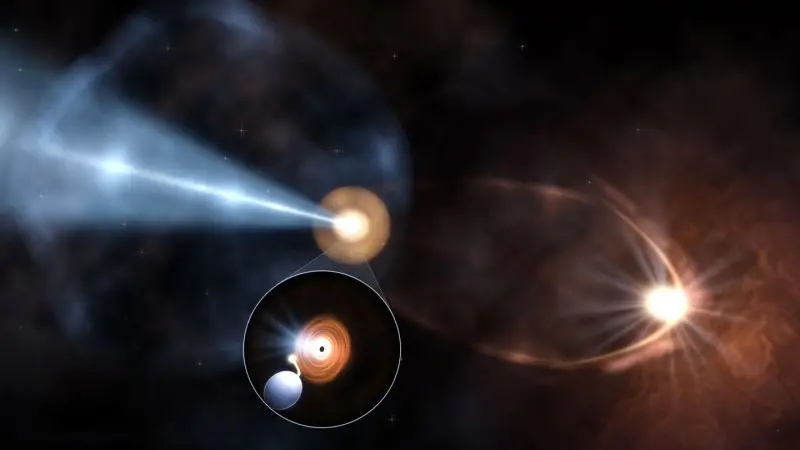
A team of astronomers announced the discovery of the first miniature quasar, or microblazar, whose jet is directed toward Earth. The observation was made using a combination of radio and optical telescopes in late 2025, and the object lies roughly 1.2 billion light‑years away in the constellation of Draco.
The find confirms a long‑awaited prediction that microblazars, smaller cousins of the powerful blazars, exist and could explain some of the mysterious high‑energy particles that reach our planet. The researchers used high‑resolution imaging to isolate the compact core and jet, measuring a rapid variability in brightness that matches theoretical models of relativistic outflows.
How Do Microblazars Differ From Their Larger Counterparts?
Microblazars are thought to accelerate particles to extreme energies, potentially contributing to the flux of cosmic rays detected on Earth. By detecting one with its jet aimed directly at us, scientists can study the emission mechanisms in unprecedented detail. The team noted that the quasar’s spectrum shows a sharp cutoff at gamma‑ray energies, suggesting a new acceleration limit for these small systems. This data could help refine models of particle acceleration in active galactic nuclei and improve our understanding of how energy is transported across vast distances.
Unlike typical blazars, which have jets spanning millions of light‑years, microblazars produce jets only a few thousand light‑years long. Their smaller size leads to faster variability, with brightness changes occurring over days instead of months. The new observation revealed a rapid flare that doubled the quasar’s luminosity within 12 hours, a timescale unprecedented for such objects. This rapid variability confirms that the emission originates from a compact region near the supermassive black hole, supporting the theory that microblazars are scaled‑down versions of larger blazars.
The discovery also raises questions about how common microblazars are in the universe. If only one has been found in over three decades of searches, future surveys with next‑generation telescopes may uncover more, offering a larger sample to test theories of jet physics and particle acceleration.
What Are the Next Steps for Observing Microblazars?
The team plans to monitor the quasar across multiple wavelengths, aiming to capture simultaneous radio, optical, and gamma‑ray data. By correlating flux variations across bands, they hope to pinpoint the exact regions where particles are accelerated. Additionally, they will search for similar objects in archival data, hoping to identify more microblazars whose jets happen to point toward Earth.
The detection of this miniature quasar opens a new window into high‑energy astrophysics. It suggests that even relatively small active galaxies can produce powerful jets capable of influencing the cosmic environment. Future observations will determine whether microblazars are a major source of the high‑energy particles that reach our planet and will refine our understanding of jet formation around supermassive black holes.
What is a microblazar? A microblazar is a small active galactic nucleus with a relativistic jet pointed toward Earth, similar to a blazar but on a much smaller scale.
Frequently Asked Questions
How was this microblazar discovered? Scientists used combined radio and optical telescopes to detect rapid brightness changes and a compact jet structure, confirming the presence of a miniature quasar.
Why is this discovery important? It provides evidence that microblazars can accelerate particles to high energies, potentially explaining some of the cosmic rays that reach Earth and offering insight into jet physics.