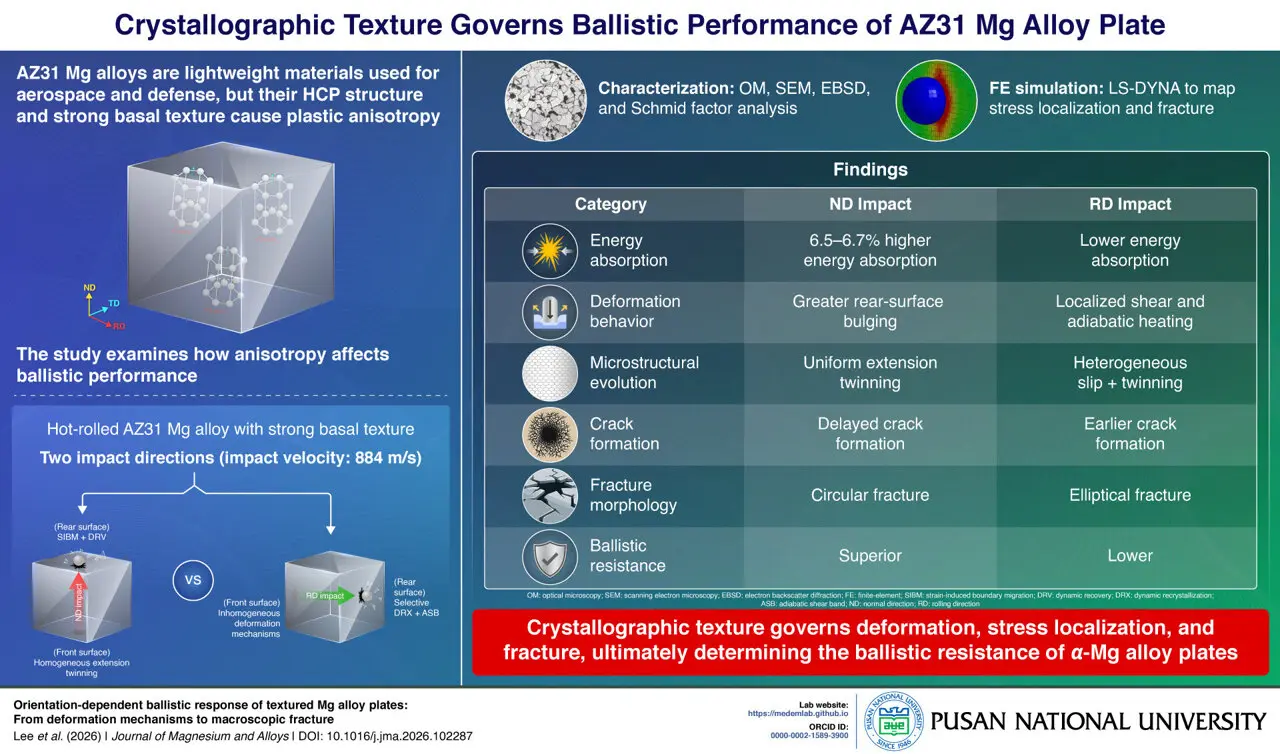
Crystal Orientation Dictates Energy Absorption
Researchers have identified that the internal crystal structure of magnesium alloys determines their ability to withstand high-speed projectile impacts. This discovery highlights a critical material property often overlooked in standard engineering designs for defense applications. The finding offers a new perspective on how to optimize lightweight armor systems for modern combat vehicles.
The study focuses on the anisotropic nature of magnesium plates. When subjected to ballistic strikes, the material does not react uniformly across all axes. Instead, the specific orientation of the hexagonal close-packed crystals dictates how energy dissipates upon impact. Engineers previously assumed isotropic behavior for many structural components, leading to potential vulnerabilities in unaligned sections. This new understanding corrects that assumption and guides future manufacturing processes.
The core mechanism involves the slip systems available within the metal lattice. Magnesium possesses limited slip systems compared to other metals like aluminum or steel. Consequently, the ease with which dislocations move depends heavily on the angle between the applied stress and the crystal planes. If the plate is aligned correctly relative to the incoming projectile, the material can deform plastically in a controlled manner. This deformation absorbs significant kinetic energy before the projectile penetrates fully. Misalignment restricts these deformation pathways, causing the material to fail prematurely under similar conditions.
Does Grain Texture Predict Armor Performance?
The research team analyzed various plate orientations using high-strain-rate testing methods. They measured penetration depth and residual velocity to quantify performance differences. The data revealed a stark contrast between optimally aligned samples and those oriented unfavorably. Plates aligned with the basal plane showed significantly higher resistance to perforation. This directional dependency suggests that bulk forming processes must account for grain texture development. Rolling and extrusion techniques naturally align grains, but the final geometry must preserve this alignment for maximum protective capability.
Yes, the texture analysis provides a reliable predictor for ballistic outcomes. By mapping the preferred crystallographic directions, engineers can simulate impact scenarios without expensive physical trials. This computational approach accelerates the design cycle for next-generation protective gear. It allows designers to tailor the microstructure of specific armor panels based on expected threat vectors. The method bridges the gap between metallurgical processing and field performance requirements.
Frequently Asked Questions
The implications extend beyond simple plate armor. Complex curved surfaces used in vehicle hulls present challenges due to varying local orientations. Understanding the baseline anisotropy helps designers compensate for these geometric variations. Future alloys may incorporate rare earth elements to enhance ductility along specific axes. This could further widen the performance gap between optimal and suboptimal alignments, making texture control even more critical.
Why does magnesium behave differently in different directions? Magnesium has a hexagonal crystal structure with limited slip systems. This means plastic deformation only occurs easily along specific crystallographic planes, making mechanical properties highly dependent on grain orientation.
How does this affect armor design? Engineers must align the strongest crystallographic directions perpendicular to expected projectile trajectories. This ensures maximum energy absorption and reduces the likelihood of catastrophic failure during impact events.