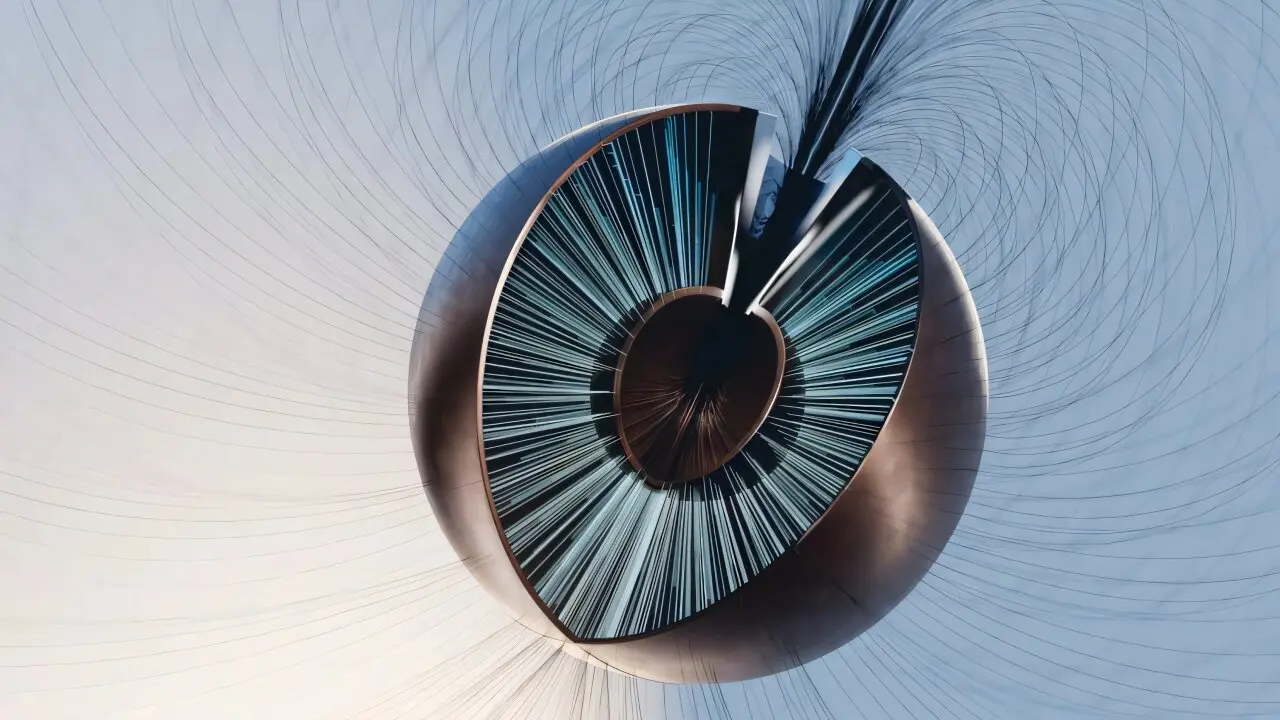
Spherical Surfaces Enable Complex Field Control
Researchers at Chalmers University of Technology have developed a method to sculpt magnetic fields into specific shapes. This innovation uses a single magnetic source to create complex field geometries. The technique relies on precise mathematical calculations rather than physical magnets. It offers a new way to control invisible forces in technology. The system operates by manipulating how magnetic flux lines distribute in space.
The core of this advancement is a concept called the magnetic omniconverter. It functions by shaping an external magnetic field using spherical surfaces. These surfaces act as boundaries that guide the field into predetermined configurations. The approach eliminates the need for multiple individual magnets. Instead, it transforms a simple, uniform input into a highly structured output. This allows engineers to design magnetic environments with greater flexibility. The method provides a level of control previously difficult to achieve.
The technology utilizes spherical surfaces to interact with the magnetic field. These surfaces do not generate their own magnetism but influence the existing field. They act as sculptors, bending the field lines into desired paths. The process requires careful mathematical modeling to predict the final shape. Engineers can now simulate various configurations before building physical prototypes. This reduces trial and error in laboratory settings. The precision of the model ensures reliable results. The system can produce fields that are difficult to create with standard permanent magnets. It opens up new possibilities for magnetic device design.
Why Does Single-Source Control Matter?
Using a single source simplifies the hardware requirements significantly. Traditional setups often require arrays of magnets to shape fields. This new method reduces component complexity and cost. It also minimizes interference between multiple magnetic sources. The single-source approach allows for cleaner experimental conditions. Researchers can isolate variables more effectively during testing. This clarity is crucial for developing advanced medical imaging tools. It also benefits industrial applications where uniformity is key. The reduction in hardware complexity leads to smaller device footprints.
The implications of this work extend across several scientific disciplines. MRI scanners could benefit from more uniform imaging fields. Particle accelerators might use this for better beam steering. The ability to sculpt fields dynamically could lead to adaptive systems. Future devices may adjust their magnetic profiles in real time. This adaptability would enhance performance in varying operational conditions. The research team plans to refine the mathematical models further. They aim to test the concept in physical laboratory environments. Success will depend on material properties and surface accuracy.
Frequently Asked Questions
How does the magnetic omniconverter work? It uses spherical surfaces to shape an external magnetic field. These surfaces guide the field lines into specific, predetermined shapes. The process relies on mathematical precision rather than physical magnet arrays.
What is the main advantage of this method? It allows for complex field shapes from a single source. This reduces hardware complexity compared to traditional multi-magnet setups. It also improves control over the resulting magnetic environment.
Where can this technology be applied? It has potential uses in MRI scanners and particle accelerators. It can also benefit industrial processes requiring precise magnetic control. The method supports the development of compact and efficient devices.