Uncovering the Secrets of Isotropic Superconductivity
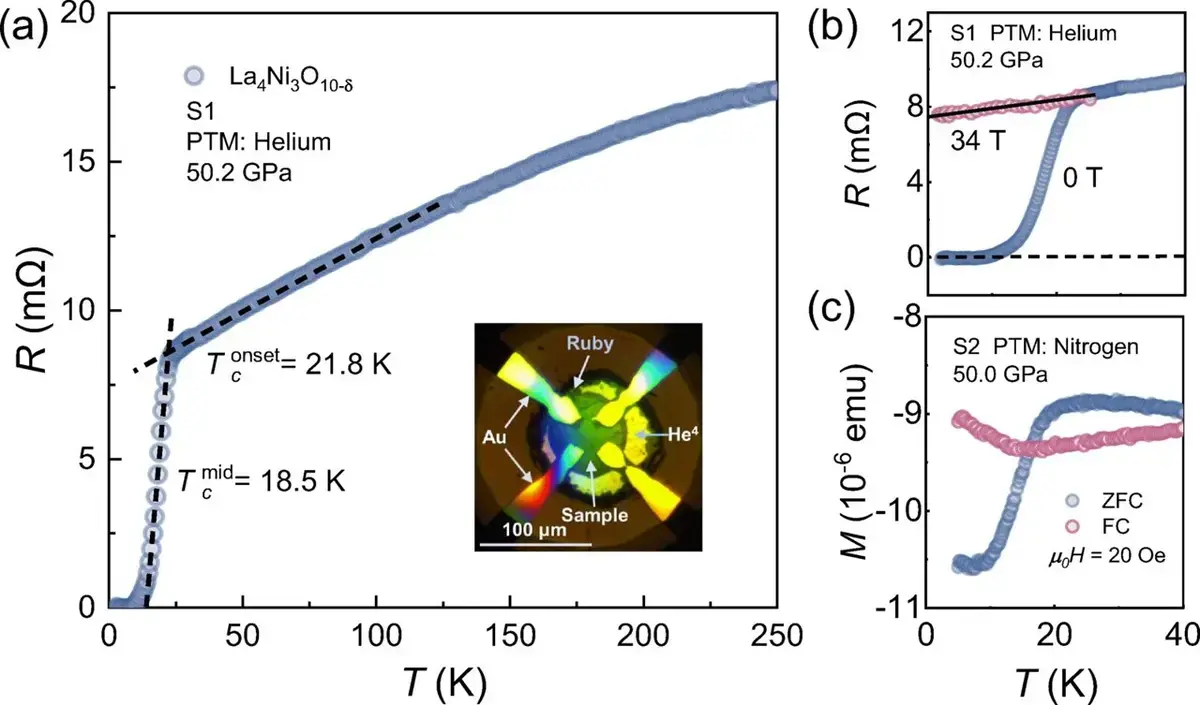
Researchers at Hefei Institutes of Physical Science discovered a nearly isotropic superconducting property in a trilayer nickelate. Led by Prof. Zhang Jinglei, the team studied La4 Ni3O10−δ single crystals under high pressure. This breakthrough was achieved through collaborative research.
The study focused on understanding the superconducting properties of La4 Ni3O10−δ. By applying high pressure, the researchers were able to induce superconductivity in the material. The team found that the superconducting property was nearly isotropic, meaning it exhibited similar characteristics in different directions.
Is Superconductivity the Future of Energy Transmission?
The researchers used high-pressure experiments to reveal the material's superconducting behavior. They observed that the upper critical field, a measure of the material's ability to withstand magnetic fields, was nearly isotropic. This suggests that the material's crystal structure plays a crucial role in its superconducting properties.
The discovery has significant implications for understanding the mechanisms behind superconductivity. The team's findings indicate that the trilayer nickelate's unique crystal structure is responsible for its nearly isotropic superconducting behavior.
The discovery of nearly isotropic superconductivity in trilayer nickelate has far-reaching consequences. It could pave the way for the development of new superconducting materials with improved performance. These materials could be used to create more efficient energy transmission systems.
Frequently Asked Questions
The study's findings open up new avenues for research into superconducting materials. As scientists continue to explore the properties of trilayer nickelate, they may uncover new insights into the mechanisms behind superconductivity.
What is isotropic superconductivity? Isotropic superconductivity refers to the ability of a material to exhibit similar superconducting properties in different directions. How was the discovery made? The discovery was made by applying high pressure to La4 Ni3O10−δ single crystals. What are the potential applications of this discovery? The discovery could lead to the development of new superconducting materials for energy transmission.