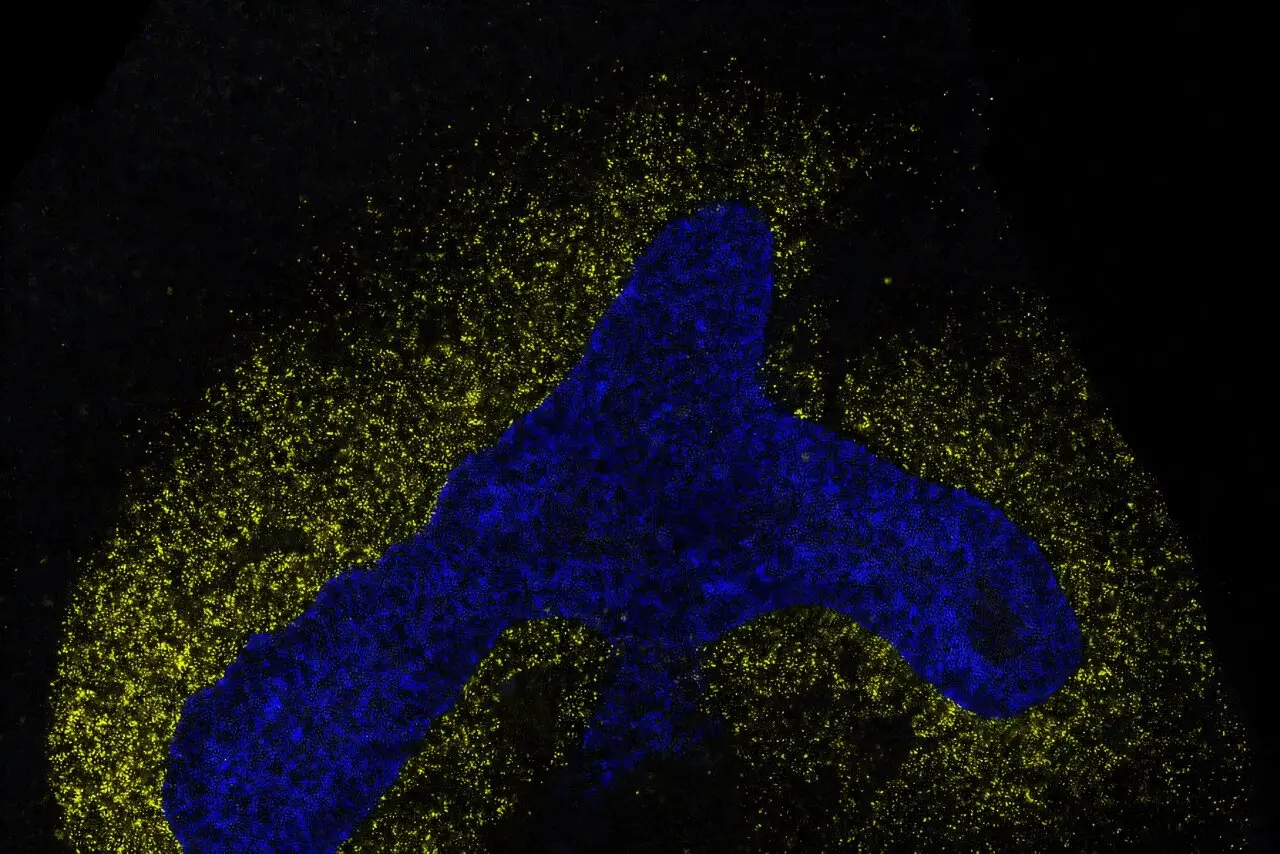
A Molecular Code Underlies Organ Formation
A new study shows that embryonic stem cells use a shared „language” of molecular signals to decide their future roles. Researchers used artificial intelligence to analyze thousands of single‑cell gene‑expression profiles from human embryos. The model identified patterns that predict whether a cell will become brain tissue, liver, muscle, or other specialized types.
The study, conducted by a team of computational biologists and developmental scientists, applied deep‑learning algorithms to high‑resolution data collected during the first weeks of human embryogenesis. By training the AI on known cell‑type markers, the model learned to recognize subtle combinations of transcription factors and signaling molecules that precede differentiation. It revealed that these signals form a coherent, hierarchical code that guides cells toward specific lineages.
How AI Unveils the Language of Life?
The AI uncovered that certain gene‑expression signatures act as checkpoints. For instance, a rise in the transcription factor SOX2 signals a neural fate, while an increase in FOXA2 nudges cells toward a hepatic lineage. These checkpoints are not isolated; they interact in a network that the model can map as a decision tree. The researchers visualized this network as a „developmental map,” showing how early stem cells branch into distinct organ‑specific pathways. The map aligns closely with known developmental biology, confirming the model’s validity.
The discovery also highlights the importance of timing. The AI identified that the same gene can have different effects depending on when it is expressed during development. Early activation of certain pathways can redirect cells away from their default fate, illustrating the plasticity of embryonic cells.
What Does This Mean for Regenerative Medicine?
By feeding the algorithm millions of data points, the researchers let the AI find patterns without human bias. The model then generated a set of rules that predict cell fate with over 90% accuracy. Scientists tested these rules on independent datasets and found that the predictions held true across different embryos and species. The AI’s ability to generalize suggests that the underlying language is conserved in vertebrate development.
The study also used the AI to simulate perturbations. When the model artificially increased or decreased specific signals, it predicted shifts in cell fate that matched experimental outcomes. This confirms that the identified language is not merely descriptive but causative.
Frequently Asked Questions
Understanding the precise language that governs cell differentiation could accelerate stem‑cell therapies. If scientists can mimic the AI‑derived signals, they may be able to direct stem cells to grow into needed tissues more efficiently. The research also offers a framework for diagnosing developmental disorders. By comparing a patient’s embryonic cells to the AI’s map, clinicians could pinpoint where the language breaks down.
The findings also raise ethical questions. As our ability to steer cell fate improves, the potential for creating complex tissues or organs in the lab grows. Regulatory bodies will need to keep pace with these technological advances.